



Framed Prints
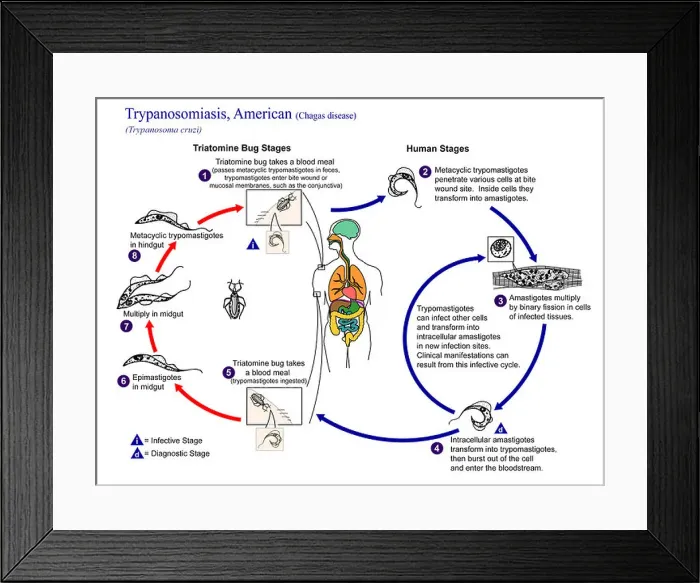
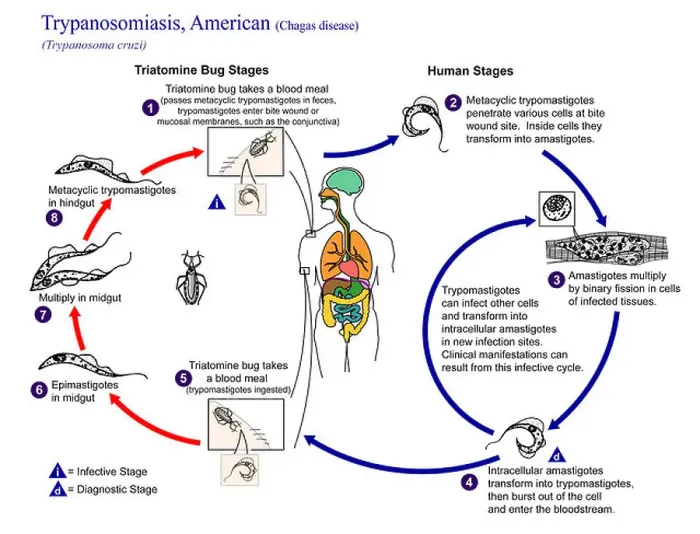
Framed Print of illustration depicting the life cycle of Trypanosoma cruzi the causal agent of American Trypanosomiasis
illustration depicting the life cycle of Trypanosoma cruzi the causal agent of American Trypanosomiasis This illustration depicts the life cycle of Trypanosoma cruzi the causal agent of American Trypanosomiasis The protozoan parasite Trypanosoma cruzi causes Chagas disease a zoonotic disease that can be transmitted to humans by blood sucking triatomine bugs An infected triatomine insect vector or kissing bug takes a blood meal and releases trypomastigotes in its feces near the site of the bite wound Trypomastigotes enter the host through the wound or through intact mucosal membranes such as the conjunctiva Common triatomine vector species for trypanosomiasis belong to the genera Triatoma Rhodinius and Panstrongylus Inside the host the trypomastigotes invade cells where they differentiate into intracellular amastigotes The amastigotes multiply by binary fission and differentiate into trypomastigotes and then are released into the circulation as bloodstream trypomastigotes Trypomastigotes infect cells from a variety of tissues and transform into intracellular amastigotes in new infection sites Clinical manifestations can result from this infective cycle The bloodstream trypomastigotes do not replicate different from the African trypanosomes Replication resumes only when the parasites enter another cell or are ingested by another vector The kissing bug becomes infected by feeding on human or animal blood that contains circulating parasites The ingested trypomastigotes transform into epimastigotes in the vectors midgut The parasites multiply and differentiate in the midgut and differentiate into infective metacyclic trypomastigotes in the hindgut Trypanosoma cruzi can also be transmitted through blood transfusions organ transplantation transplacentally and in laboratory accidents The geographic distribution of the disease is the Americas from the southern United States to southern Argentina Mostly in poor rural areas of Central and South America Chronic Chagas disease is a major health problem in many L. © Scott Camazine
Your chosen combination is quickly and professionally made to order, our shipping page has more details
If you are not entirely happy with your items, simply return them to us within 30 days for a replacement or full refund. Please read our full returns policy.
Media ID 41459410
Agent Blood Disease Epidemiology Illness Kissing Micrograph Parasite Pathogen Plague Protozoan Smear Technique Zoonotic
Modern Frame 14"x12" (36x31cm)
Ready to Hang Contemporary Framed Prints adds style, protection, and a polished touch to your space - effortlessly.
Your artwork will be printed as shown in the preview. To adjust please select Edit Printed Image under the Buy button
Wood effect frame, card mounted, 10x8 fade resistant photo print. Overall outside dimensions 14x12 inches (36x31cm). Environmentally and ozone friendly, 40mm wide x 15mm Polycore® moulding has the look of real wood, is durable and light and easy to hang. Biodegradable and made with non-chlorinated gases (no toxic fumes) it is efficient; producing 100 tons of polystyrene can save 300 tons of trees! Prints are glazed with lightweight, shatterproof, optical clarity acrylic (providing the same general protection from the environment as glass). The back is stapled hardboard with a sawtooth hanger attached. Note: measurements provided are estimated outer dimensions, which include both the image and the frame. While we aim to keep sizing consistent, exact dimensions may vary slightly due to differences in print size or production requirements, which may result in a variation in the overall size (up to approximately 2.5cm (1"))
These are individually made so all sizes are approximate
Estimated Image Size (if not cropped) is 24.4cm x 18.6cm (9.6" x 7.3")
Estimated Product Size is 36cm x 31cm (14.2" x 12.2")