
Framed Prints
Framed Print of Bulletin of the British Museum (Natural History)
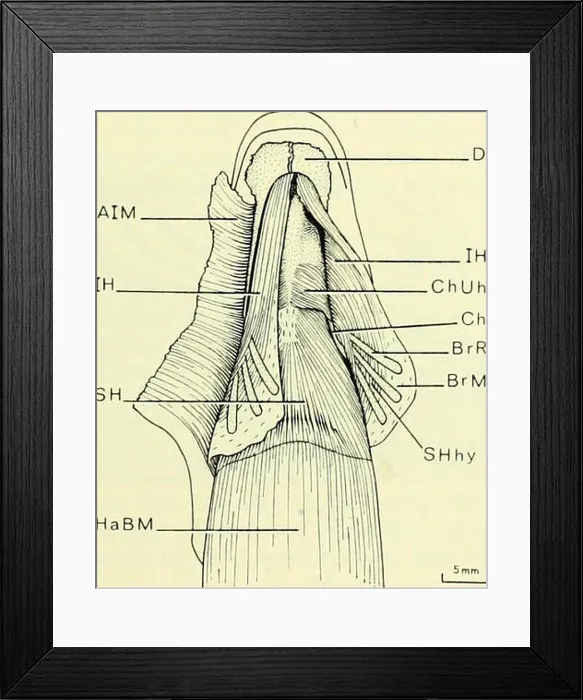
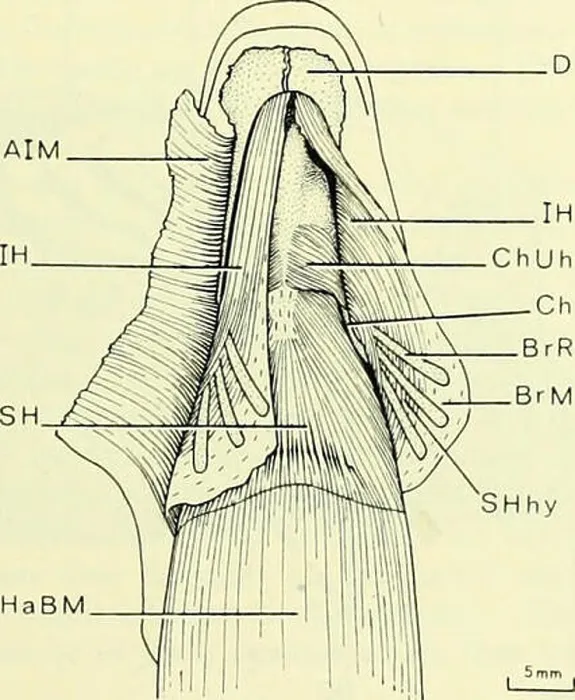
Bulletin of the British Museum (Natural History). OSTEOGLOSSOMORPH HYOID MUSCULATURE 45 fig. 20). Neither muscle meets the other at any point, although they are closely aligned anteriorly. The muscles originate in part from the epi- and ceratohyal, and in part from the first branchiostegal ray. In large individuals each muscle is incompletely divided, horizontally, so as to virtually form a small dorsal and larger ventral muscle (text-fig. 20). The ventral subdivision is that described above; the dorsal part originates on the epihyal and inserts on the inner face of the dentary about halfway. Bulletin of the British Museum (Natural History). OSTEOGLOSSOMORPH HYOID MUSCULATURE 45 fig. 20). Neither muscle meets the other at any point, although they are closely aligned anteriorly. The muscles originate in part from the epi- and ceratohyal, and in part from the first branchiostegal ray. In large individuals each muscle is incompletely divided, horizontally, so as to virtually form a small dorsal and larger ventral muscle (text-fig. 20). The ventral subdivision is that described above; the dorsal part originates on the epihyal and inserts on the inner face of the dentary about halfway along its length. The smallest fish examined (14-0 cm standard length) has no division, or even incipient division, in the muscle; consequently the single muscle on each side appears to have a double insertion, one anteriorly and the other laterally at about the middle of the dentary. These muscles (or muscle) correspond, in most details, to the interhyoideus of mormyrids, and are identified as such in Gymnarchns. One difference in the interhyoid of Gymnarchns is the considerable proportion of muscle originating from the first branchiostegal ray (text-fig. 20). In mormyrids the interhyoid originates exclusively from the hyoid bar, and there is complete separation between the interhyoid and the hyohyoideus. The situation in Gymnar- chns is very different. In fact, the muscle described above could well be a combined inter- and hyohyoideus. In Gymnarchns the only clearly recognizable hyohyoideus is the superior or interbranchiostegal ray portion (text-fig. 20); here it is represented by a few, well-spaced oblique fibres running between the branchiostegal rays. No distinct inferior hyohyoid can be recognized. Indeed, those fibres, which, topo-. HaB [•'iG. 20. Gymnarchns niloticits: ventral hyoid musculature. Anterior intermandibularis cut and reflected to the right; left interhyoideus reflected to the left.. Please note that these images are extracted from scanned page images th. © Book Worm
Your chosen combination is quickly and professionally made to order, our shipping page has more details
If you are not entirely happy with your items, simply return them to us within 30 days for a replacement or full refund. Please read our full returns policy.
Media ID 48217766
Analysis Anatomical Behavior Classification Comparative Divisions Evolution Evolutionary Feeding Function Functionality Marine Biology Mechanics Mechanisms Movement Muscle Muscles Muscular Musculature Osteology Physiological Physiology Studies Vertebrates Zoological
Modern Frame 14"x12" (36x31cm)
Ready to Hang Contemporary Framed Prints adds style, protection, and a polished touch to your space - effortlessly.
Your artwork will be printed as shown in the preview. To adjust please select Edit Printed Image under the Buy button
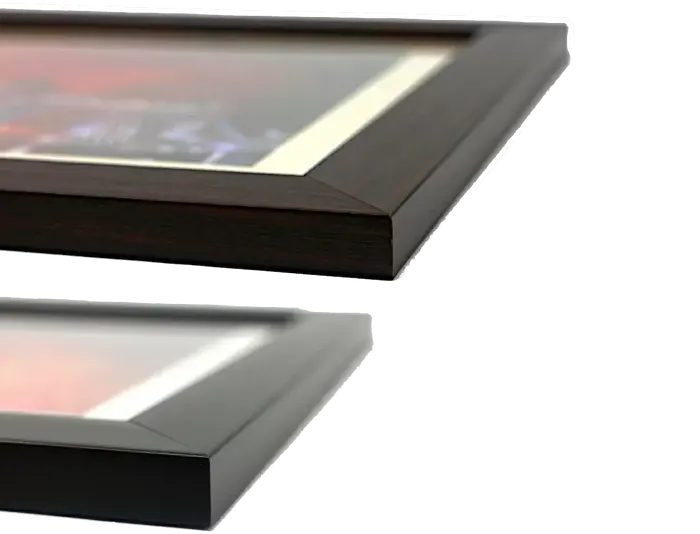
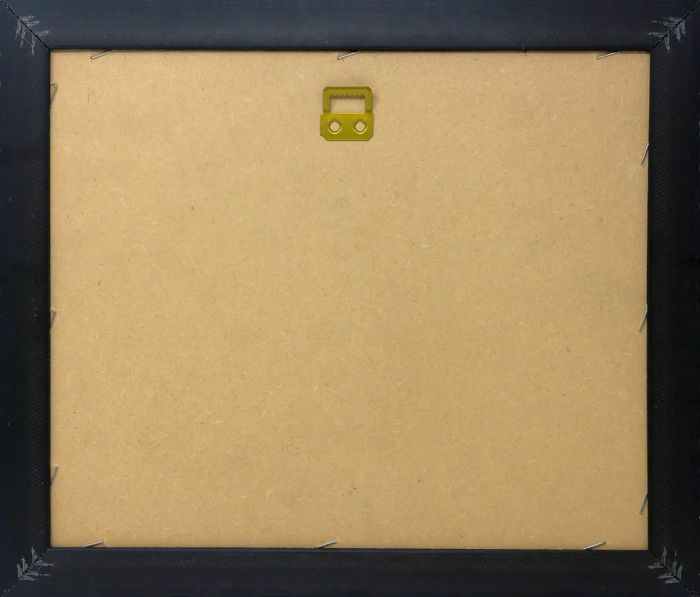
Wood effect frame, card mounted, 10x8 fade resistant photo print. Overall outside dimensions 14x12 inches (36x31cm). Environmentally and ozone friendly, 40mm wide x 15mm Polycore® moulding has the look of real wood, is durable and light and easy to hang. Biodegradable and made with non-chlorinated gases (no toxic fumes) it is efficient; producing 100 tons of polystyrene can save 300 tons of trees! Prints are glazed with lightweight, shatterproof, optical clarity acrylic (providing the same general protection from the environment as glass). The back is stapled hardboard with a sawtooth hanger attached. Note: measurements provided are estimated outer dimensions, which include both the image and the frame. While we aim to keep sizing consistent, exact dimensions may vary slightly due to differences in print size or production requirements, which may result in a variation in the overall size (up to approximately 2.5cm (1"))
These are individually made so all sizes are approximate
Estimated Image Size (if not cropped) is 19.3cm x 23.5cm (7.6" x 9.3")
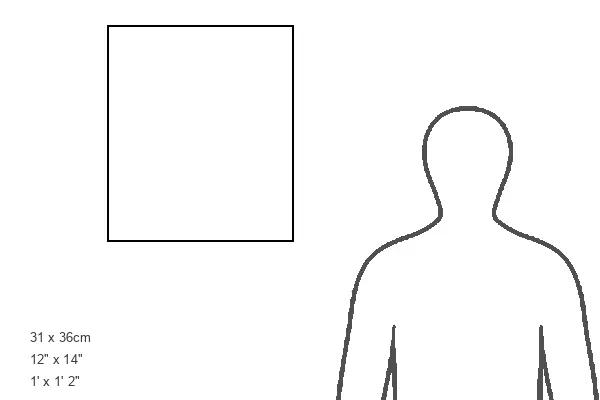
Estimated Product Size is 31cm x 36cm (12.2" x 14.2")